A unified dispatch & resource-allocation platform across 18 governorates for faster response and coordinated emergency management
A Virtual Central Network (VCN) design that interconnects all Iraqi fire stations (18 governorates) into a centralized dispatch and coordination platform. The system accepts citizen reports, computes optimal dispatching, and dynamically reallocates resources while preserving security and high availability. Core technical components and capabilities:
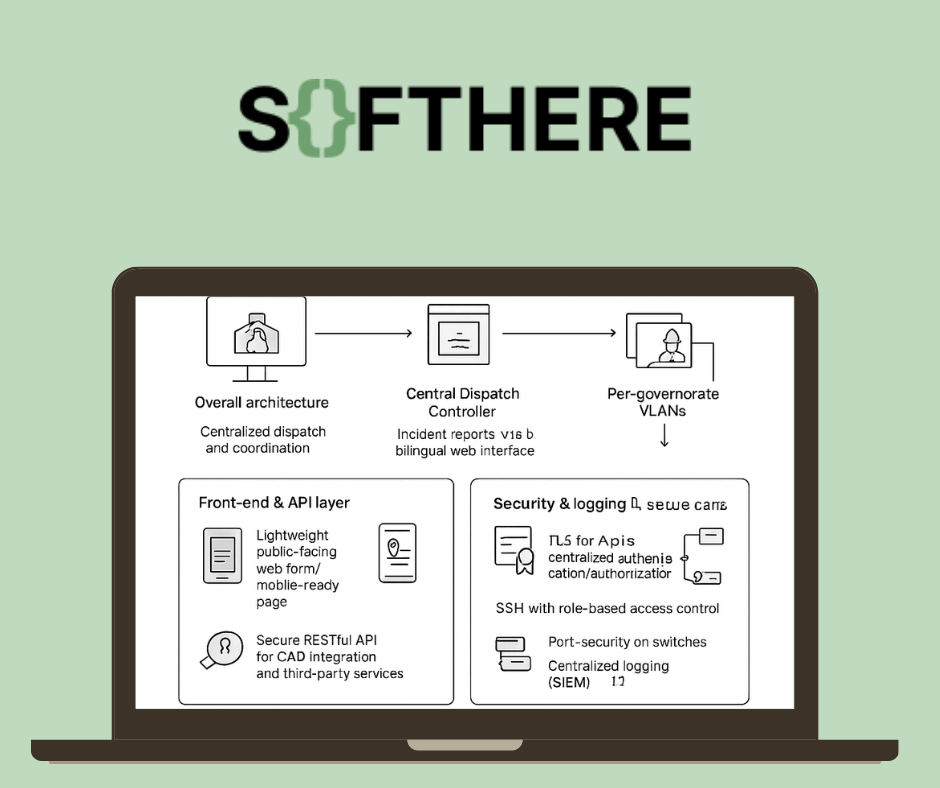
Overall architecture
Central Dispatch Controller receives incident reports via a bilingual web interface and forwards them to the appropriate governorate network or nearest available station.
Per-governorate VLANs and segmented subnets to isolate operational traffic.
Front-end & API layer
Lightweight public-facing web form/mobile-ready page that accepts personal info and location (manual input and GPS).
Secure RESTful API for CAD integration and third-party services (ambulance, police).
Availability detection & routing logic
Station status monitoring (Available/Busy/Maintenance) via heartbeats.
Routing/assignment algorithm using GIS proximity, estimated time-of-arrival (ETA), resource state, and priority to select the best responder or nearest fallback.
Network protocols & device management
OSPF for internal routing, VLAN segmentation per station, SSH-based remote management and configuration for network devices.
IP addressing plan and subnetting for predictable routing and access control.
Security & logging
TLS for APIs, centralized authentication/authorization, SSH with role-based access control, port-security on switches, and centralized logging/SIEM for intrusion detection and forensics.
High availability & fault tolerance
Redundant dispatch servers and automated failover; local fallback mode at station level to operate during intermittent central connectivity loss.
Resource allocation & decision engine
Real-time allocation engine that dispatches vehicles/teams based on priority, type of incident, ETA and traffic conditions. Supports pre-deployment strategies for critical periods.
GIS & routing integration
Integration with mapping services (e.g., OSM or commercial providers) for live routing, ETA calculations, and visualization of incidents/asset locations on the central dashboard.
Simulation & validation
Network design validated using simulators (Cisco Packet Tracer etc.), load/stress tests, disaster scenario simulations, and security penetration testing.
KPIs & reporting
Response time metrics (avg/max), request fulfillment ratio, deployment time, and resource utilization dashboards for operational oversight and policy decisions.
Constraints & mitigation strategies
Address limited connectivity and power outages using LTE/5G failover, UPS/generators, edge-processing for local autonomy, and phased training programs to overcome personnel skill gaps.
Future extensions
Live video feeds (RTSP/WebRTC), interoperability with ambulance/police CADs, real-time analytics for demand forecasting, and IoT sensor integration for proactive alerts